From Coast to Coast
Coastal Ecologies, Post-Colonial Heritages
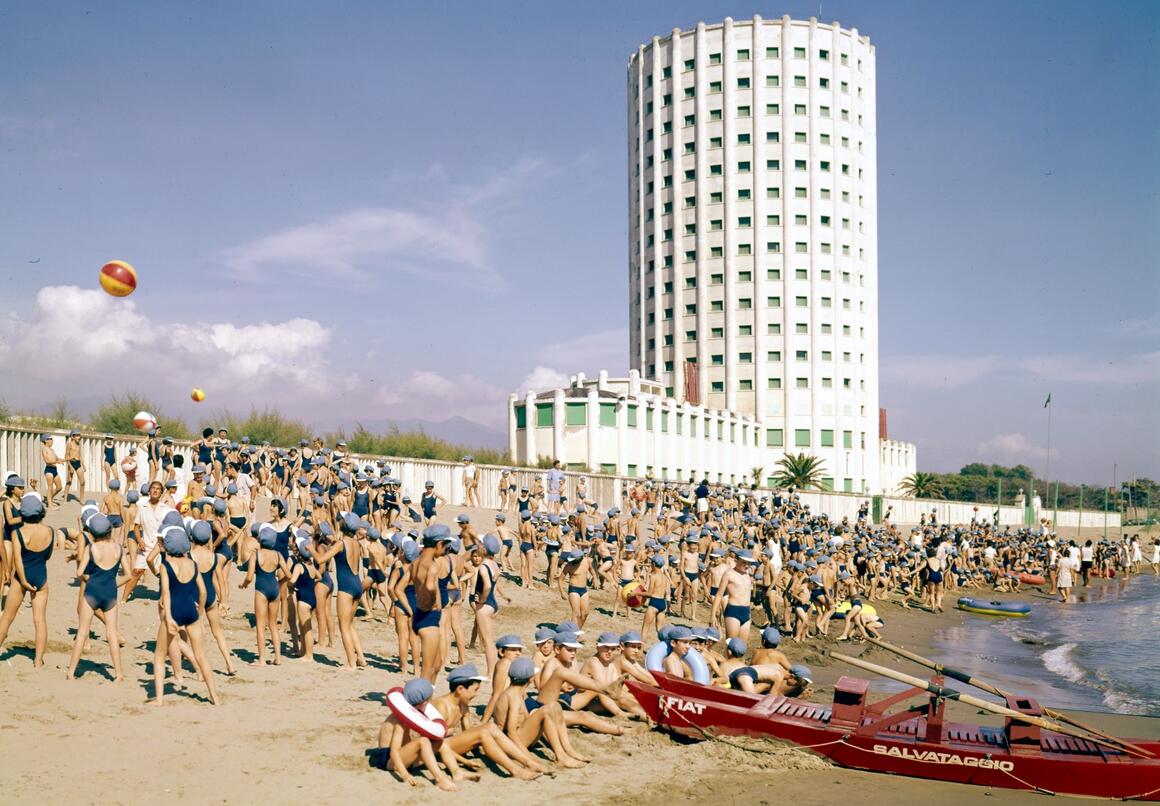
The event stems from an investigation initiated by the Festival Post-Colonia into the troubled legacy of seaside summer camps built under Italian fascism.
The history of these marine architectures—and the ruins they have left behind—becomes a lens through which to reflect on resonant built and natural environments, from the Mediterranean to the North Sea.
Drawing on his recent books Mussolini’s Nature (2022) and Wastocene (2021), Marco Armiero weaves together the “natural” history of Italian fascism with contemporary economies of waste and toxic narratives.
Curators Heidi Ballet, Martina Angelotti, and Emanuele Guidi present their work on coastal environments and explore artistic and curatorial approaches—respectively through the Beaufort Triennale and Post-Colonia—as sites for speculation, research, and forms of commoning.
Post Colonia is an initiative by LAMA, co-directed by Martina Angelotti, Emanuele Guidi and Francesca Marzocchi.
The project is supported by the Architecture Festival – 3rd Edition, promoted by the General Directorate for Contemporary Creativity of the Ministry of Culture.
BOOK HERE
Martina Angelotti is an art curator and writer whose research explores the intersections between art and politics. She conceives and produces exhibitions, performances, and contemporary art projects, including film festivals, workshops, conferences, and publications. She is currently the curator of the Department of Visual Art at Fondazione Ratti (Como), where she develops a long-term program investigating the relationship between artistic and ecological practices. Since 2007, she has been the artistic director and co-founder of ON (Bologna), a project dedicated to the dialogue between art and the public sphere. From 2014 to 2020, she served as artistic director of Careof (Milan). Her writings include essays and artist monographs published by Mousse, NERO, Treccani, and Postmedia Books. Recent publications include Visible. Art as Policies for Care (co-curated with Matteo Lucchetti and Judith Wielander, NERO Ed, 2024); Beyond Archive (Edizioni di Comunità, 2020); and the Italian edition of The Inheritance (Meltemi, 2023), a graphic novel by anthropologist and artist Elizabeth Povinelli, which she edited and translated.
Marco Armiero is an ICREA Research Professor at the Institute of History of Science at the Autonomous University of Barcelona and at the Catalan Institute for Research and Advanced Studies. For ten years, he directed the Environmental Humanities Lab at the Royal Institute of Technology in Stockholm. His book Wasteocene: Stories from the Global Dump, published by Cambridge University Press, has been translated into Italian, Spanish, French, and Serbo-Croatian, and will soon be available in Chinese, Portuguese, and Indonesian.
Heidi Ballet works as a curator at DE SINGEL arts centre in Antwerp and as a professor in the In Situ department at the Royal Academy of Fine Arts in Antwerp. Her curatorial practice often engages with interdisciplinary questions at the intersection of art, science, and society. She has curated several public art projects, including And So, Change Comes in Waves, an outdoor parcours commissioned by the University of Leuven in 2025. She also served as the artistic director of the Beaufort Triennial along the Belgian coast in 2018 and 2021. Previous curatorial projects include the 2019 Tallinn Photomonth Biennial, the 2017 Lofoten International Art Festival (LIAF), and the 2016 Satellite exhibition series at Jeu de Paume in Paris and CAPC in Bordeaux. From 2012 to 2015, she was a research curator at Haus der Kulturen der Welt (HKW) in Berlin, where she contributed to the projects After Year Zero and Ape Culture.
Emanuele Guidi is writer, curator and reserarcher. Guidi is currently a PhD candidate in Practice in Curating at the University of Reading (UK) and the ZHdK Zurich (CH). In 2024, he was a fellow at the Archiv der Avantgarden in Dresden, for which he published Henry Martin: An Active Ear (Spector Books, 2024). He is lectuter in curatorial studies and art and ecology at NABA, Milan. Between 2013 and 2022, he was artistic director of ar/ge kunst, Kunstverein in Bolzano, developing interdisciplinary programs between visual arts, architecture and political ecology, curating exhibitions of artists such as Jumana Manna, Mohamed Bourouissa, Otobong Nkanga and Slavs and Tatars. Other projects and exhibitions include: hostileenvironments.eu (2020-2021); Silver Rights, Elena Mazzi (Södertäljie Konsthal, Sweden and Bienalsur/Museo Udaondo, 2021); Shadow Writings, Lorenzo Sandoval (Centro Párraga, Murcia, 2020).
