Building for Quantum
Europalia
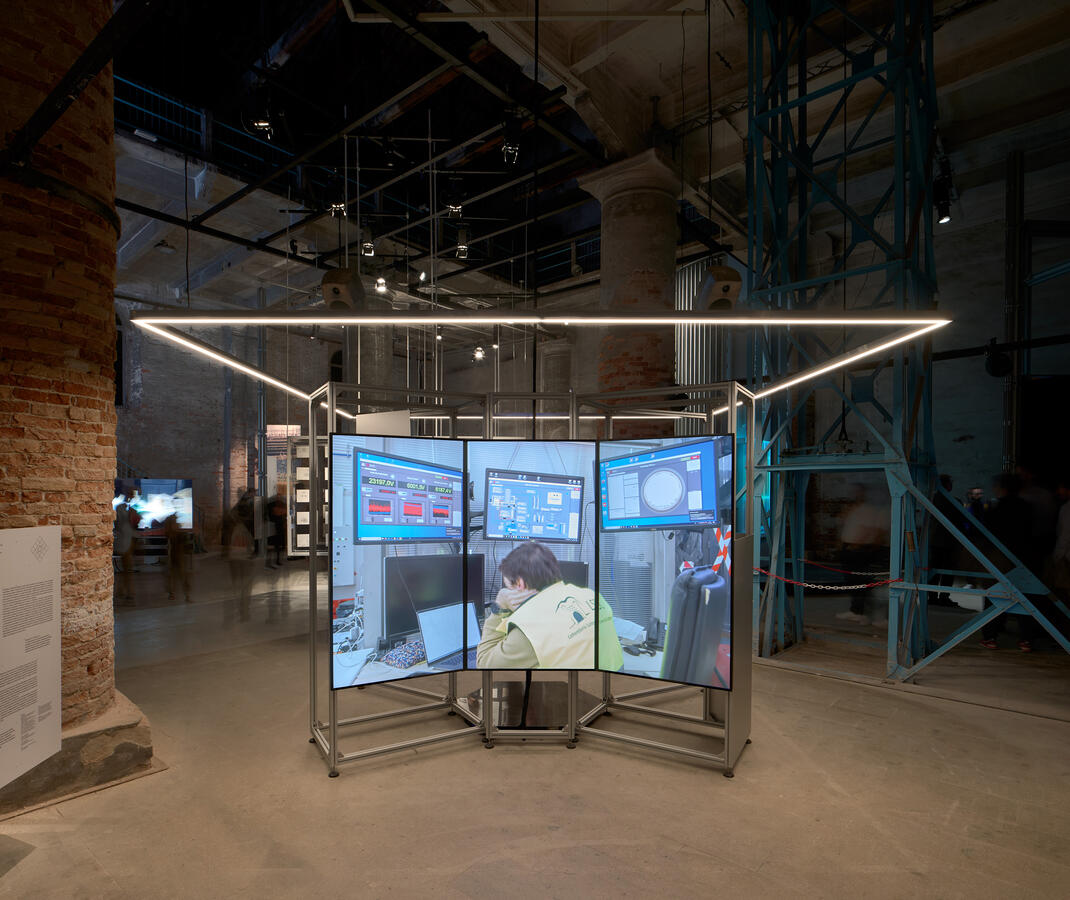
© José Hevia
In the frame of Europalia and curated by Marina Otero, Building for Quantum explores the architectures, imaginaries, and geopolitical implications of quantum technologies, data infrastructures, and planetary-scale computation. It unfolds in two parts: an afternoon film screening and panel discussion, followed by an evening keynote lecture. The program aims to bridge artistic research, scientific insight, and speculative design, aligning with Europalia’s commitment to cultural inquiry and transdisciplinary dialogue. It seeks to contribute to current cultural debates on infrastructural aesthetics, techno-political futures, and the ethics of innovation.
Co-orgnised by:
In collaboration with:
BOOK HERE
PROGRAM OUTLINE
Afternoon Program: Screening & Panel
Building for Quantum – Screening & Conversation
17:00–19:00
Screening: 17:00–17:30
This segment presents Building for Quantum, a film directed by Manuel Correa, Marina Otero, Manu Sancho, and Emil Olsen, recently featured in the official selection of the 2025 Venice Architecture Biennale. The film follows the construction of the Basque Quantum (BasQ) headquarters in Donostia, an initiative promoted by Ikerbasque and led by the Department of Science, Universities and Innovation of the Basque Government, together with the three Provincial Councils. Set to host one of the world’s most powerful quantum computers, the building becomes a lens through which the film explores the imaginaries, political agendas, and aspirations surrounding the arrival of this transformative technology. As quantum computing begins to redefine the boundaries of knowledge, Building for Quantum examines how architecture is being mobilized to materialize a new computational paradigm.
The Quantum System Two is the first modular quantum architecture, designed to enable the connection of multiple quantum computers to form systems capable of addressing problems far beyond the reach of today’s classical supercomputers. The film navigates the intersection of the physical and the philosophical within quantum architecture—juxtaposing the tangible, ordinary materials of brick and mortar with the meticulous precision required to sustain near-perfect vacuum chambers at temperatures colder than deep space.
Delving into the daily challenges of constructing this architecture, the film goes behind the scenes to offer a glimpse into the manipulation of matter and the technological, human, and labor efforts involved. Quantum computing holds the promise of unveiling new understandings of the world, of space, and, by extension, of architecture itself. By processing data in multidimensional spaces, it enables insights into the behavior of subatomic particles and mobilizes key principles of quantum mechanics: superposition, entanglement, decoherence, and interference. Building for Quantum dwells in the tension between the raw realities of construction, the surgical precision of machine processes, and the digital simulations that emerge within its circuits.
Panel Discussion (Post-Screening): 17:30–19:00
A conversation between the directors and special guests:
Javier Aizpurua – Director, BasQ
Monica Bello – Former Curator and Head of Arts at CERN
Abelardo Gil-Fournier – Artist and researcher
Marina Otero – Architect and researcher
Manuel Correa – Filmmaker and artist
Manu Sancho – Architect and researcher
Evening Program: Lecture by Marina Otero Verzier
Data Mourning
19:15–20:30
What does it mean to grieve in an age of digital excess and environmental collapse? In this keynote, Marina Otero Verzier examines the entangled politics of data, memory, and mourning through the architectures of digital infrastructure. Drawing on her ongoing research on the transformation of planetary systems in the era of AI and quantum computing, she considers the ecological and emotional toll of data accumulation—where servers hum with the residues of extraction, loss, and erasure.
Otero reimagines mourning not as a process of closure, but as a continuous, material relation with what (and who) persists. She traces how grief reverberates across infrastructures of storage, the politics of computation, and shifting design scales—from the mineral foundations of digital technology to its cosmic ambitions. In this context, mourning emerges as a critical practice: of accountability, resistance, and the reconfiguration of our attachments to the living and the dead.
